IMPORTANCE OF COMPUTER
Looking back to the first computers and microcomputers, and
then looking ahead at what’s coming next
in the use of computers, it’s clear that modern computer systems are
helping to build our future, driving and supporting progress, innovation, and
connectivity. And the advancement of computer technology continues to open up
new frontiers of possibility.

So what, exactly, do we mean when we refer to computer
systems?
A computer system is the term used for all of the
interconnected computer hardware and software components that work together to
run a computer, allowing it to receive, store, process and transmit information
and data.
Typical systems will include a few key components that
ensure their computerswork. These include:
A central processing unit (CPU), which executes
instructions.
A motherboard, which is the most important bit of circuitry
in the system, enabling all its other components to effectively interact with
one another.

An operating system, such as Apple iOS, the Macintosh MacOS
operating system, Linux, Unix, or the Microsoft Windows operating system.
Operating systems like these provide the interface between the user and the
computer as well as its peripherals, such as any monitors, keyboards, and mice.
Various types of computer software. This includes everything
from word processors – the technology used for word processing tools such as
Microsoft Word – and the web browsers that enable people to use the web when
they have an internet connection.
Storage devices for short term memory – which is called
random access memory, or RAM – and long term memory – such as hard disk drives
(HDD) – which are housed on a computer’s hard drive.
THE BENEFITS OF COMPUTER SYSTEMS
Computer systems offer a number of established benefits,
including:
Increased efficiency and productivity. Computer systems help
people perform complex tasks with unparalleled speed and accuracy. Automated
processes save time and effort, which leads to increased productivity in
people’s personal and professional lives.
Essential information management. Computer systems enable
people to store, organise, and retrieve vast amounts of information. And with
sophisticated databases and search engines, people can access knowledge with
just a few clicks or keystrokes, making research and data analysis more
efficient than ever before.Enhanced communication and connectivity. The advent
of computer networks and the internet has revolutionised communication. Email,
social media, video conferencing, and instant messaging have transformed how
people connect and collaborate with others around the world.

THE IMPORTANCE OF COMPUTER SYSTEMS IN THE BUSINESS WORLD
Computer systems have become an indispensable tool in
business. They have reshaped every aspect of modern organisations, from
high-level decision-making and operations, to marketing and customer service.
This is because computer systems support:
Streamlined operations. Computer systems automate routine
tasks, optimise inventory management, and facilitate efficient supply chain
operations.
Business intelligence. Computer systems can collect and
analyse huge amounts of data, helping businesses to gain valuable insights into
customer behaviour, market trends, and financial performance. This means that
businesses and organisations can make data-driven decisions, identify new
opportunities for growth, and stay ahead of their competitors.
Enhanced customer experiences. Computer systems support
personalised marketing activities, more tailored and efficient customer support,
and seamless online transactions. These enhanced customer interactions can help
build customer loyalty – and business growth.
THE IMPORTANCE OF COMPUTER SYSTEMS IN EDUCATION
Computer systems play a significant role in education,
transforming the way knowledge is gathered and shared. This is because computer
systems support:
Access to information. Computers and the internet provide
pupils, students, and educators with access to virtually limitless amounts of
information and educational resources. These resources, such as online
libraries, digital textbooks, and educational websites, also expand learning
opportunities.
Interactive learning. Computer systems offer interactive
learning experiences through multimedia, simulations, and other educational
software. Learners can engage in virtual experiments, immersive simulations,
and collaborative projects to further enhance their understanding.
Digital literacy. Through computer systems, learners develop
proficiency in areas that are crucial for people living in this digital age.
Learning computer science, coding, and computer literacy equips people with
essential skills for the 21st century, empowering them to adapt, innovate, and
succeed in an increasingly technology-driven world.
THE IMPORTANCE OF COMPUTER SYSTEMS IN HEALTHCARE
Computer systems have enabled huge changes in healthcare –
and have empowered healthcare providers, researchers, and patients alike. This
is because computer systems support:
Efficient medical recordkeeping and data management.
Electronic health records and data management systems mean that healthcare
providers can store, access, and share patient information securely.
Advanced diagnostics and treatment options. Computer systems
support medical imaging technologies, such as MRI and CT scans, which enable
more precise diagnoses and effective treatment planning. Computer-assisted
surgeries, robotic systems, and real-time monitoring devices have also been
hugely beneficial for healthcare delivery and improving patient outcomes.
Medical research. With the aid of computer systems,
researchers can analyse large medical datasets, which assists in accelerating
discoveries and advancing medical knowledge. Artificial intelligence and machine
learning algorithms also help in predicting disease patterns, identifying risk
factors, and developing personalised treatment strategies.
THE FUTURE OF COMPUTER SYSTEMS
Emerging technologies in a number of key areas are expected
to further transform our world. These areas include:
Quantum computing. According to IBM, quantum computing
“harnesses the laws of quantum mechanics to solve problems too complex for
classical computers.” This technology is still in its infancy, but aims to
support everything from electric vehicles to addressing energy challenges.
Artificial intelligence (AI) and machine learning.
Advancements in AI and machine learning algorithms will support further
development in everything from virtual assistants and self-driving cars to more
personalised medicine and smart homes.
The Internet of Things (IoT). It’s predicted that the IoT
will eventually connect billions of devices and sensors, creating a network of
interconnected systems that support smart cities, industrial automation, and even
precision agriculture.
ACCELERATE YOUR CAREER IN COMPUTER SYSTEMS
Join the high-demand field of computer science by studying
the 100% online MSc Computer Science at Keele University. This flexible,
part-time programme has been designed for ambitious individuals who may not
have studied computer science previously, as well as computer science
professionals who want an academic qualification to accelerate their career
progression in information technology.
You’ll develop and extend the practical skills you need for
designing, building, deploying, and evaluating software and computer
applications in a variety of contexts. You will learn programming and web
languages including Python, Java, and XML, work with mobile apps, and learn to
develop modern software systems and applications.
Key areas of study include:
the fundamentals of computer science
design and programming
user interaction (UI) design
statistical data analytics and databases
software engineering
web technologies and security
advanced programming techniques
In today's fast-paced digital world, computer skills have
become essential for almost every career. With the advent of new technologies
and increasing reliance on digital platforms, employers seek candidates with
strong computer skills. Whether you are a software developer, a graphic
designer, a marketing professional, or a healthcare provider, having strong
computer skills can help you to enhance your productivity, streamline your work
processes, and boost your career prospects.
In this informative blog post, we will explore why computer
skills are essential for your career in 2023. We will discuss the benefits of
having strong computer skills, the types of computer skills in demand, and how
you can acquire and improve your computer skills. Whether you are a recent
graduate or an experienced professional, this post will provide valuable
insights on staying ahead of the curve and succeeding in the rapidly changing
job market. So, read on to discover why computer skills are necessary for your
career in 2023.
Why Computer Skills Are Essential in Today’s Digital Age?
In today's digital age, computer skills have become
essential for success in many areas of life, including education, work, and
personal pursuits. Computers and digital devices have revolutionized how we
live and work, making accessing information, communicating with others, and
completing tasks easier.
Here are some reasons why computer skills are essential in
today's digital age:
Efficiency: With computer skills, you can perform tasks
faster and more efficiently. For example, you can use a computer to create and
edit documents, send emails, and conduct online research. It can help you to
save time and increase productivity.
Communication: Computers and digital devices have
revolutionized communication, making it easier to stay connected. With computer
skills, you can communicate through email, social media, video conferencing,
and other digital platforms.
Career Advancement: Many jobs require computer skills, and
having strong computer skills can help you to advance your career. With the
ability to use software programs, conduct research, and analyze data, you can
stand out from other candidates and increase your chances of landing a job or
promotion.
Access to Information: With computer skills, you can access
vast amounts of information through the internet. Search engines and other
tools can find information on any topic anywhere.
Creativity: Computers and digital devices can be used for
creative pursuits such as graphic design, video editing, and music production.
With computer skills, you can unleash your creativity and express yourself in
new and exciting ways.
Discuss the Impact That Computer Skills Have on Job
Prospects, Career Advancement, and Personal Growth
Computer skills significantly impact job prospects, career
advancement, and personal growth. In today's digital age, employers value
candidates with strong computer skills, which can open up many career
opportunities. Here are some ways in which computer skills can impact job
prospects, career advancement, and personal growth:
Job Prospects
Many job roles today require computer skills, and having
these skills can make you a more attractive candidate for job openings.
According to the Bureau of Labor Statistics (BLS), employment in computer and
information technology occupations is projected to grow by 21% from 2021 to
2031, much faster than average for all occupations.
Additionally, a study by Burning Glass Technologies found
that nearly 8 in 10 middle-skill jobs (jobs that require some education and
training beyond high school but less than a bachelor's degree) require digital
skills such as using Microsoft Office, social media platforms, and other
software applications.
For example, computer skills are essential for IT, software
development, marketing, and finance careers. Computer skills can also help you
stand out from other candidates, increase your chances of landing a job, and
earn a higher salary.
Career Advancement
Computer skills can also be critical for career advancement.
With solid computer skills, you can automate routine tasks, analyze data more
effectively, and communicate with colleagues more efficiently. These skills can
help you to become more productive, work more effectively with others, and earn
promotions or leadership positions within your organization.
A study by Deloitte found that digital-savvy companies are
more likely to achieve their business goals than their less digitally-savvy
counterparts. Strong computer skills can help professionals become more
productive and effective in their work, potentially leading to promotions and
career growth.
Personal Growth
Computer skills can contribute to personal growth besides
job prospects and career advancement. With computer skills, you can learn new
things, explore new hobbies, and communicate with friends and family. For example,
you can use social media to connect with people from different backgrounds or
learn new coding or graphic design skills.
A study by Pew Research Center found that 73% of adults use
YouTube to learn how to do things they have never done before. It suggests that
digital platforms can be used for personal growth and learning. Additionally, a
survey by the American Association of Retired Persons (AARP) found that seniors
who use the internet and digital devices report higher levels of social
engagement, mental stimulation, and overall well-being.
Types of Computer Skills
Computer skills can be broadly classified into basic and
advanced.
Basic Computer Skills
Basic computer skills are fundamental skills that are
essential for anyone who wants to use a computer. These skills are required for
tasks such as sending emails, using social media, browsing the internet, and
completing basic office tasks. Here are some of the most important basic
computer skills:
Navigating an Operating System: Understanding how to
navigate an operating system such as Windows or MacOS is essential for opening
and closing programs, saving and retrieving files, and customizing settings.
Using Word Processing Software: Word processing software
such as Microsoft Word is used for creating and formatting documents such as
resumes, cover letters, and reports.
Using Email: Understanding how to send and receive email is
essential for communication in the modern workplace. Basic skills include
composing and sending messages, attaching files, and organizing messages into
folders.
Using Web Browsers: Web browsers such as Google Chrome or
Mozilla Firefox are used for browsing the internet. Basic skills include
navigating websites, using bookmarks, and completing online forms.
Using Social Media: Social media platforms such as Facebook,
Twitter, and LinkedIn are used for networking, marketing, and communication.
Basic skills include creating a profile, posting updates, and interacting with
other users.
Basic computer skills are versatile and can be applied in
various personal and professional settings. Here are some examples of how basic
computer skills can be used in different settings:
Personal Use: Basic computer skills are helpful for personal
tasks such as online shopping, managing finances, and staying connected with
friends and family. Individuals can use their computer skills to search for
information, watch movies or TV shows, and access online resources for learning
or entertainment.
Education: Basic computer skills are essential from
elementary school to college. Students use computers for research, writing
papers, and completing assignments. Teachers and educators use basic computer
skills to create lesson plans, manage student data, and provide online
resources for students.
Business: Most office jobs require basic computer skills,
from administrative assistants to managers. Employees use computers for tasks
such as sending emails, creating spreadsheets, and producing reports. Employers
also use computer skills to manage projects, analyze data, and communicate with
clients and customers.
Healthcare: Basic computer skills are increasingly important
in the healthcare industry. Medical professionals use computers to manage
patient records, analyze medical data, and communicate with other healthcare
professionals. Patients also use basic computer skills to access healthcare
information and resources online.
Non-Profit: Non-profit organizations use basic computer
skills to manage donor databases, communicate with volunteers, and promote
their cause online. Basic computer skills are also helpful in creating
marketing materials, managing social media accounts, and creating online
fundraising campaigns.
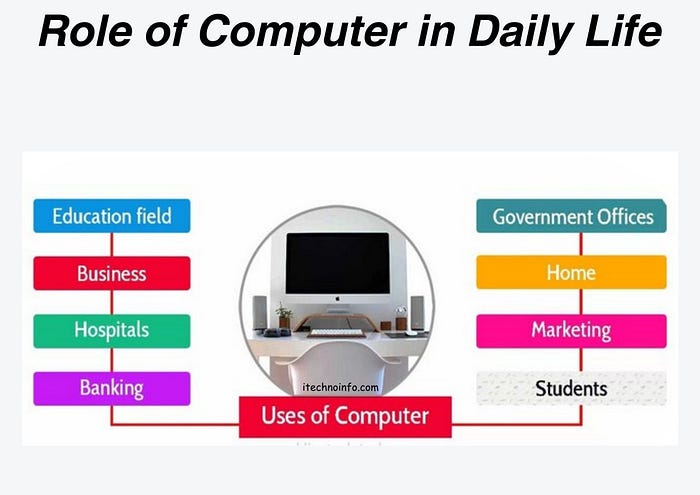
Uses of Computer in Daily Life
Computers play a focal role in various aspects of daily
life. Computers have transformed Daily life in numerous ways, revolutionizing
the teaching, learning, medical, banking etc process across all levels. Here in
this article we are provide some key Computer in our Daily Life which has
changed the daily routine life very effectively and positively.
Computers play a vital role in Daily routine life cycle
system, revolutionizing various aspects of communication, work and business
experience, entertainment, healthcare,teaching system, online classes process,
research, and administration. Here are in this article, we get full knowledge
about Essay on computer and Computer in our Daily Life
Here we are present 10 Important “Uses of Computer in Daily
Life” for growing your more knowledge about this daily life topic like Role of
Computer in daily life and Importance of computer in our daily life.
Best 10 Uses of Computer in Hospital
Uses of Computer in Education
10 Important “Uses of Computer in our Daily Life” are as
follows :-
1.) Communication:
Computers enable instant communication through email,
messaging apps, social media, and video calls, connecting people globally.
2.) Information Access:
They provide access to an immense amount of information and
resources on the internet, aiding research, learning, and staying updated on
news and trends.
Also Read:- Top 12 Uses of Computer | What is a Computer? |
Definition of Computer | Latest Uses of Computer at Home
3.) Work and Business:
This is best example of usage of computer in our daily life.
Computers are essential for offices, facilitating tasks such as document
creation, data management, accounting, and communication. They also support
businesses through online transactions and marketing.
Uses of Computer in Education
4.) Education Sector:
They are extensively used in education, supporting online
learning, research, interactive lessons, and access to educational materials.
5.) Entertainment:
Computers offer a wide array of entertainment options like
gaming, streaming movies and music, social media, and creative software for
digital art and content creation.
6.) Healthcare:
They assist in patient data management, medical imaging,
research, and development of treatments and medical technology.
Easy 2 Ways of How I Make Bootable Pendrive For Windows and
Mac OS
7.) Banking and Finance:
Computers power online banking, stock trading, financial
analysis, and secure transactions, making financial processes faster and more
accessible.
8.) Transportation:
Computers are integral in managing traffic, logistics,
navigation systems, and scheduling in transportation industries.
Also Read:- How to Create Yahoo Mail Account| 6 easy Steps
9.) Home Use:
They serve various purposes at home, from managing schedules
and finances to entertainment and ‘smart home devices’ control.
10.) Scientific Research:
Computers are indispensable in scientific research for
simulations, data analysis, modeling complex systems, and conducting
experiments.
Top 12 Uses of Computer | What is a Computer? | Definition
of Computer.
** The role of computers in daily life continues to expand,
influencing almost every aspect of modern living. Their versatility and
capabilities have significantly transformed the way we work, learn,
communicate, and entertain ourselves. **
Stay connected with itechnoinfo.com for more
effective,working solutions & Updates.
Conclusion
Computers have become an integral part of daily life,
revolutionizing various aspects of human existence. From communication and
education to work and entertainment, their uses are vast and impactful. In
essence, computers have become indispensable in modern life, transforming how
we communicate, work, learn, entertain ourselves, and manage our daily
routines. Their adaptability and versatility continue to shape and enhance our
lives in countless ways.
How to Create Yahoo Mail Account| 6 easy Steps
How to Partition c drive in Windows 10/11 Easy Steps
Hope!! you will get all important and possible Fixings about “10 Important Uses of Computer in Daily life” and you done it very well


Students working on corporate finance topics often need additional support to understand financial models and analysis techniques. Using corporate finance assignment help helps improve clarity and ensures assignments are completed with proper research and structure.
ReplyDelete